Some designs are born from necessity, but the most iconic ones turn necessity into art. A century ago, watches were mostly round—easy to craft, familiar to wear, but rarely bold enough to challenge tradition. Then came a timepiece inspired by the raw power of military machinery, yet refined to fit beneath a dress cuff: a watch that reimagined what a wristwatch could be, one sharp, elegant line at a time. This is the Cartier Tank, the “square watch pioneer” that turned the utilitarian spirit of WWI tanks into a symbol of understated luxury. It’s not just a watch; it’s a lesson in how great design can bridge function and beauty, crafted for those who value heritage as much as style.
The Tank’s story began in 1917, when Louis Cartier drew inspiration from the British Mark I tank—then a revolutionary weapon in WWI. He didn’t copy the tank’s bulk; instead, he distilled its essence: the rectangular shape of its hull, the horizontal “brancards” (side rails) that mimicked the tank’s treads, and the clean, uncluttered lines that spoke to efficiency. The result was a watch unlike any other: a slim rectangular case (the “square” spirit that broke round-watch norms), with subtle metal rails framing the dial, and Roman numerals that added a touch of classic Cartier elegance. It was an instant hit—worn by soldiers returning from war, then by artists, politicians, and style icons who fell for its quiet boldness. Over the decades, the Tank evolved (into models like the Tank Louis Cartier, Tank Solo, and Tank Francaise) but never lost its core: that same rectangular grace that made it a pioneer.
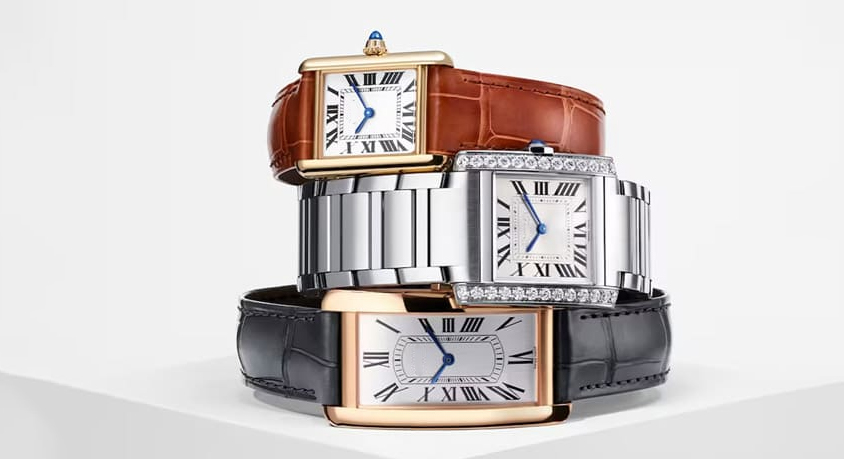
Crafting a Cartier Tank is a masterclass in restraint. Its case—whether 18K rose gold, white gold, platinum, or stainless steel—is milled from a single block of metal, then polished to a soft sheen that avoids excess shine. The “brancards” aren’t just decorative; they reinforce the case’s structure while adding visual depth, their edges smoothed to avoid catching on cuffs. The dial is equally deliberate: crisp white or deep navy, with Cartier’s signature blue steel hands (heated to that perfect hue) and Roman numerals that are slightly curved, as if hugging the dial’s edges. Beneath the surface lies a slim, precise movement—often Cartier’s in-house Caliber 049 for automatic models—designed to stay thin enough to keep the Tank’s sleek profile. Even the crown, set with a tiny blue sapphire, is a small nod to luxury, never overshadowing the watch’s minimalist charm.
What makes the Tank endure is its versatility. It doesn’t demand attention, but it always commands it. Slide it beneath a tailored suit for a Boston board meeting, and its rectangular case adds a sharp contrast to the round cuffs, a quiet sign of taste. Wear it with a cashmere sweater on a weekend brunch, and its slim profile feels lightweight, almost like a second skin. Even at a wedding, passed down from mother to daughter, it shines—its gold case warming against the skin, its dial catching candlelight like a tiny, elegant mirror. Unlike trend-driven watches that feel dated after a season, the Tank’s design is eternal; its rectangular shape and clean lines never go out of style. It’s a watch that grows with you, adapting from your first professional job to your retirement, a constant in a changing world.
For collectors, the Tank is a treasure. Vintage models—like the 1920s Tank Louis Cartier or the mid-century Tank Cintrée—fetch premium prices at auctions, their value driven by Cartier’s uncompromising quality and the Tank’s status as a design pioneer. Even modern Tanks hold their worth, thanks to limited production runs and the brand’s commitment to preserving the watch’s original spirit. But the real value isn’t monetary; it’s the way the Tank becomes part of your story: marking promotions, anniversaries, and quiet moments when you glance down and see not just time, but a piece of history.