Most drivers treat the tire pressure sticker on their driver’s side B-pillar like a divine commandment handed down from the gods of engineering. They see that "32 PSI" or "35 PSI" and assume that as long as the little yellow horseshoe light isn't screaming on the dashboard, their car is operating at peak performance. I’m here to tell you that following that sticker blindly is like wearing a winter parka in the middle of a Miami July just because the manufacturer’s catalog showed a guy looking cozy in the snow. That number on your door sill is a compromise, a beige middle ground designed by lawyers to balance fuel economy, liability, and a soft ride for people who think a steering wheel is just a place to rest their hands while listening to podcasts. If you actually care about how your car carves a corner or stops in an emergency, you need to stop treating that sticker as the final word.
Last week, I was pushing a BMW M340i through a set of tight switchbacks on a crisp, 40-degree morning in the Appalachians. By noon, the sun was baking the asphalt to nearly 90 degrees. If I had left my tires at the "cold" pressure recommended on the door, my handling would have gone from surgical precision to feeling like I was driving a damp marshmallow by lunchtime. Tires are essentially rubber balloons filled with air that expands and contracts with every ten-degree shift in temperature. In the American Midwest, where you can wake up to frost and drive home in a heatwave, your tire pressure is a moving target. In Southeast Asia, where the afternoon sun can turn a road into a frying pan in minutes, that "recommended" pressure can spike so high that your contact patch—the only four bits of rubber connecting you to the planet—shrinks to the size of a postage stamp.
Think of your tire’s contact patch like the grip of a heavy-duty work boot. When the pressure is too high, the tire crowns, and you’re basically walking on your tiptoes; when it’s too low, the sidewalls roll over, and you’re stumbling on your heels. The door sticker is calculated for a "max load" scenario—think of a suburban dad taking the kids to a soccer tournament with a trunk full of orange slices and folding chairs. If you’re flying solo on a Monday morning commute, that rear tire pressure is likely way too high, causing the back end of the car to feel skittish and nervous over mid-corner bumps. I’ve driven Teslas where the recommended pressure is pumped up to 42 PSI just to squeeze out an extra five miles of range, but the result is a ride so brittle it feels like you’re rolling on granite blocks, transmitting every pebble directly into your spine.
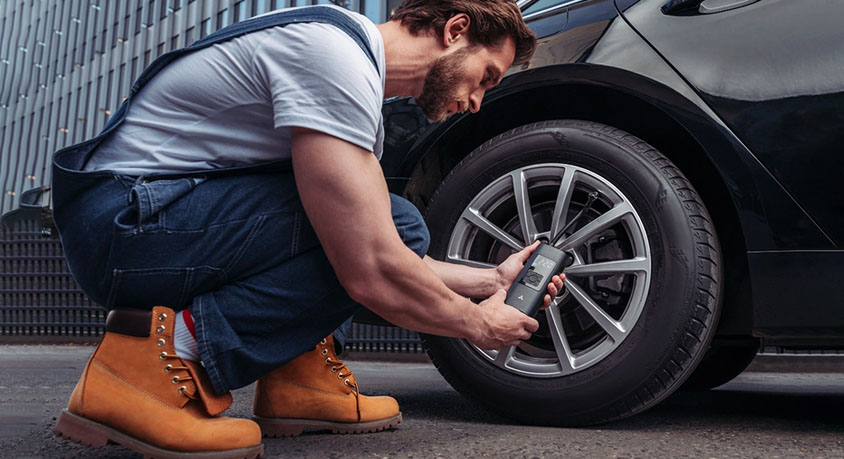
I have a particular hatred for the modern obsession with low-profile tires on massive 21-inch rims. They look great in a brochure, but they have zero margin for error when it comes to pressure. On a car like the Ford Mustang Mach-E, those big wheels combined with "Eco" tire pressures make the steering feel like you’re holding a vibrating PS5 controller rather than a mechanical linkage. There is no nuance, no "talk-back" from the road. If you drop the pressure by just three pounds to find some grip, you risk bending a rim on the first pothole you hit. Conversely, a Honda Civic Type R handles like it’s on rails because its engineers actually want you to play with the settings, but even then, the factory recommendation is just a starting point for a very specific set of conditions that probably don't exist in your driveway.
When you’re heading to Home Depot to load up on bags of mulch, yes, pump those tires up to the sticker's "Max Load" spec. The extra air supports the weight and keeps the sidewalls from overheating. But when you’re heading out for a weekend drive on your favorite backroad, you want to adjust for the "hot" pressure. A tire that starts at 32 PSI cold might hit 39 PSI after twenty minutes of hard driving. That 7 PSI swing is the difference between a car that rotates beautifully around a mountain bend and a car that plows straight ahead in a fit of terminal understeer. You should feel the steering wheel get lighter and more vague as the pressure climbs too high; it starts to lose that "meaty" resistance that tells you exactly how much grip you have left before the front end gives up.
We live in a world where manufacturers try to idiot-proof everything, from lane-keep assist that tugs at your hands like a nervous toddler to touchscreens that replace perfectly good volume knobs. I despise the fact that I have to dig through three sub-menus just to see my tire pressures on some modern German cars. Give me an analog gauge and a real-time readout any day. The "perfect" pressure is a balance between the ambient air temperature, the weight in your seats, and how hard you plan to push the car. If you live in a place with massive seasonal swings, you should be checking your pressures every two weeks, not once a year during an oil change.
The next time you’re getting ready for a long road trip or just a spirited run to the coast, ignore the B-pillar for a second. Buy a high-quality digital gauge—not the five-dollar pen-style junk from a gas station—and start experimenting. Start at the factory spec, drive your favorite loop, and then let out two pounds. Feel how the car settles. Feel how the feedback through the rim changes from a sharp "clack" to a dull "thud" over expansion joints. You’ll find that the "secret number" that makes your car handle perfectly isn't printed on a sticker by a factory worker in a different time zone. It’s a number you find yourself, through your own hands and the seat of your pants. Don't let a lawyer's compromise ruin the one thing that makes driving worth it.