Geneva, 1971. The Swiss watch industry sleeps in gold-lined coffins, unaware it's about to be resurrected in steel. A young Gerald Genta receives a midnight call: "Design a waterproof luxury sports watch by morning." By dawn, history's most radical sketch emerges not on paper, but on a restaurant napkin. The Royal Oak is born: not just a timepiece, but a cultural detonation where industrial muscle meets haute horlogerie finesse.
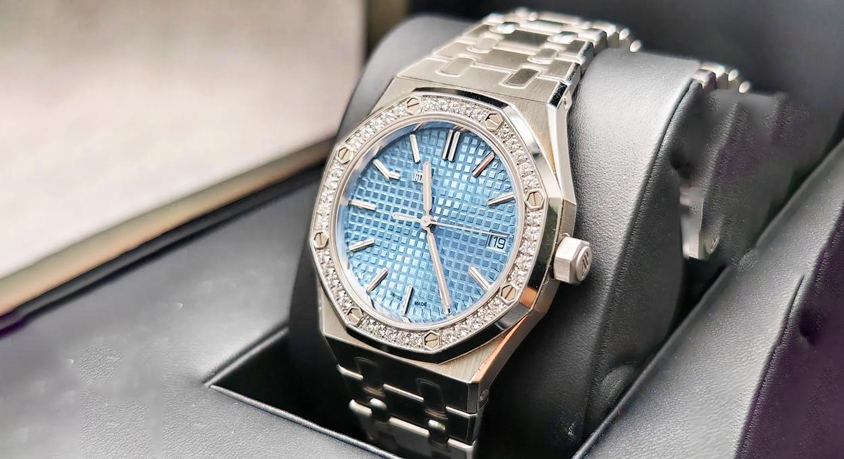
Hold the 1972 reference 5402ST. Feel its heretical weight 39mm of brushed steel when dress watches barely touched 34mm. That octagonal bezel? Machined from solid steel, its eight polished screws defiantly exposed like a ship's porthole hence its name, inspired by Britain's oak-armored warships. Each screw is perfectly aligned at 30-degree angles, secured from beneath with invisible tension washers. This is engineering as theater.
Slide it under a loupe. The "Petite Tapisserie" dial reveals its secret: not stamped, but painstakingly guillochéd by 19th-century machines retrofitted with diamond bits. Each tiny pyramid is hand-checked 124 per square centimeter creating a moiré effect that shimmers like chainmail in motion. The white gold applied markers? So finely faceted they disappear edge-on, reappearing as lightning strikes when light hits.
Open the caseback. At just 3.05mm thick slimmer than most dress watch movements Caliber 2121 packs 36 jewels and a 22k gold micro-rotor. Its balance wheel beats at 19,800 vph, slower than contemporaries, giving it the smooth, hypnotic sweep of a shark gliding through deep water. This movement powered history: from 1972's steel original to 1993's "John Mayer-approved" ultra-thin perpetual calendar.
Evolution of an Icon
1978 "Jumbo" 5402SA: First gold Royal Oak, its warmth softening the industrial edge
1980s "Kong" 25654: 42mm thunderbolt with vertical-taped dial
1992 "Offshore" 25721: 42mm beast that birthed the luxury sports watch
2012 "15202IP: Platinum case with black ceramic bezel horological stealth wealth
New York architect Daniel Libeskind wears his 15400 while sketching: "Its geometry is Mies van der Rohe meets Brooklyn Bridge." Tokyo restaurateur Mika Tanaka pairs her 37mm frosted gold with sushi knives: "Both balance precision and artistry." Most poignant? Retired astronaut Chris Hadfield's 14790ST: "Timed reentries over Kazakhstan. Earth looked as fragile as the watch's polish."
Collector Secrets
Early "A-series" (1972-76) have matte dials and "AP" logo at 6 o'clock
"Double-stamped" 5402s (accidentally marked twice) fetch six figures
1995 "Tuscan" dials with burnt orange hue are the rarest
"Extra-Thin" 15202's movement takes 30% longer to assemble
The Royal Oak didn't just break rules it rewrote them. Before 1972, steel was for tool watches; after, it became luxury's new lingua franca. That first ₣3,750 price (ten times a Rolex Submariner) now seems prophetic today's iterations command years-long waitlists.
But its true genius is alchemical: transforming cold metal into emotional heirlooms. The scratch on your bezel from that Barcelona honeymoon? The bracelet's stretch from decades of wear? These aren't flaws they're your life's patina, woven into a design revolutionary enough to carry them.
When you strap on a Royal Oak, you're not just wearing a watch. You're clasping 50 years of horological insurgency the same machine that timed stock market coups, counted contractions during home births, and pulsed beneath shirtsleeves during history-making handshakes. The Royal Oak doesn't tell time it chronicles how we reshape the world. After all, isn't the ultimate luxury having the courage to reinvent the rules?