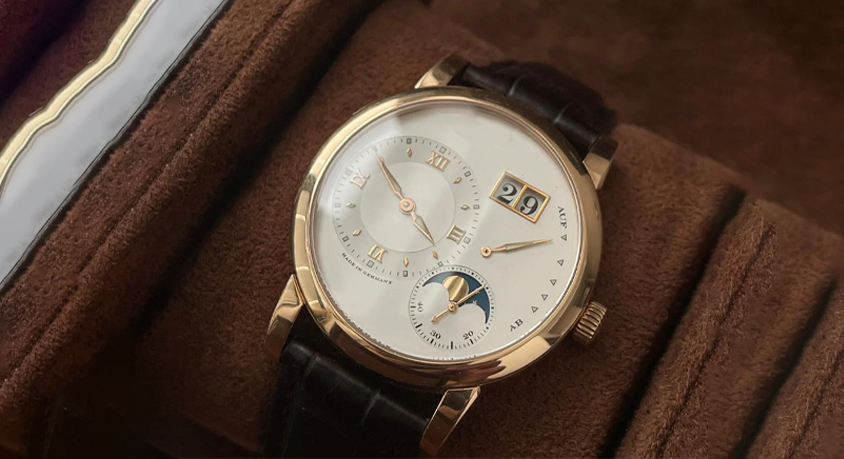
Glashütte, December 7, 1994. Frost etches the windows of a workshop silenced for 45 years by Soviet occupation. Walter Lange—grandson of the founding watchmaker—places the final screw into Caliber L901.0. Before him lies not just a timepiece, but a manifesto: the Lange 1, its dial an intentional rebellion against symmetry, its gears singing the resurrection of German haute horlogerie. This was no revival—it was revolution disguised in argenté silver and honey gold.
Examine the dial through a loupe magnifier. That off-center hours-and-minutes dial? Precisely 1/3 larger than the small seconds subdial, positioned according to the Golden Ratio. The overlapping outsize date window—a double-aperture display requiring 46 additional components—hovers like a proclamation above 4 o'clock. This isn't asymmetry for novelty; it's visual tension orchestrated with Bauhaus rigor. Each Roman numeral is laser-engraved into solid silver before being filled with black lacquer, depth-charging the dial like antique letterpress type. The blued steel hands, tempered over beechwood charcoal until reaching *mittelblau* (mid-blue), sweep without intersecting—a dance of perpetual nearness.
Beneath the sapphire caseback lies German engineering as high art. The three-quarter plate—carved from untreated German silver that ages to antique champagne—reveals Glashütte stripes polished at 12° intervals. The balance cock is hand-engraved with *tremblage* (a vibrating chisel technique) creating frost-like textures unique to each watchmaker. Here beats Caliber L121.1, housing a twin mainspring barrel delivering 72 hours of power. The magic lives in the patented oscillation system: a free-sprung balance spring with six inertia screws, accurate to within 0.7 seconds daily despite gravity's pull. This movement isn't assembled; it's architectured, each angle beveled by hand until edges vanish like morning mist over the Ore Mountains.
Wearers become custodians of resurrection. Dresden architect Markus Weber wears his platinum Lange 1 while drafting: "Its imbalance centers me—reminding me beauty thrives beyond perfect grids." Silicon Valley CEO Priya Desai gifts the "Lumen" edition (with translucent date wheel) to engineers: "For those who see poetry in exposing hidden mechanisms." Most poignant? Berlin gallery owner Anja Vogel's 1994 first-edition: "My grandfather traded his last cigar for it during reunification shortages. The serial number—'94'—is our family's rebirth year."
Collectors speak in coded details. Early models (1994-2001) feature "honey gold" cases—a proprietary alloy warmer than rose gold—discontinued due to wartime alloy secrets lost. Pre-2005 movements show deeper engraving where masters still recalled pre-war techniques. The rarest? 1999 "Tremblage" editions with entirely hand-frosted plates, mimicking winter frost on Saxon windows. Notice the evolution: original solid casebacks gave way to sapphire exhibitions in 2015, revealing the balance cock's hypnotic tremor.
Caring for this mechanical phoenix demands reverence. Wind daily at 7 AM—47 half-turns to maintain torque equilibrium. Clean the case with microfiber cloths stroked radially from the crown. Store in watch winders programmed for 650 turns/day—mimicking a curator's gentle gait through Glashütte's vaults. Most crucially: service only at Lange's glass-walled manufacture, where restorers use microscopes once trained on Dresden's art salvage.
The Lange 1 endures not despite its asymmetry, but because of it. That scratch near the date window? It survived champagne flutes at the Brandenburg Gate reopening. The patina on German silver plates? It absorbed decades of midnight oil as you rebuilt companies or translated Rilke. A. Lange & Söhne crafted more than a watch—they bottled the resilience of a culture that refused to die. When you strap it on before signing peace treaties or custody agreements, you're not wearing horology. You're carrying Glashütte's phoenix rising from Cold War ashes—a machine that counted seconds through revolutions, counted heartbeats through chemotherapy, and still dares to declare that broken things can become more beautiful than perfection. After all, isn't the greatest luxury not forgetting what was lost, but rebuilding it with unwavering hands?