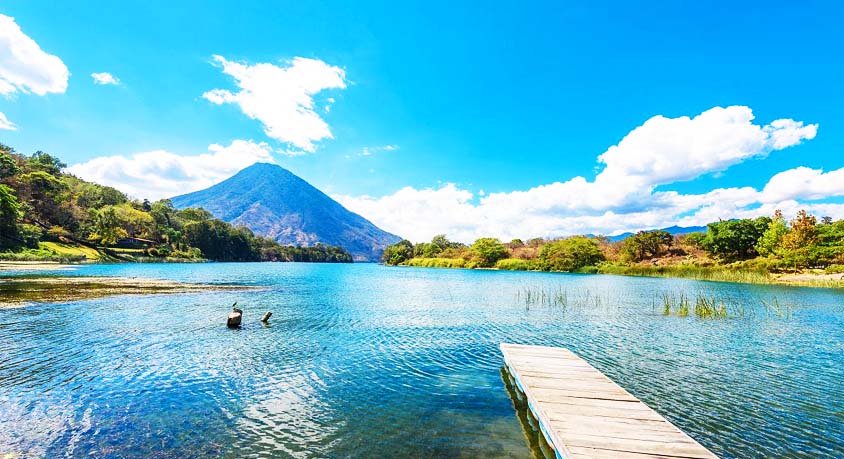
The fog pulled back like a velvet curtain, revealing the jagged, coal-colored silhouette of Volcán San Pedro just as the first slice of orange light hit the water. I was shivering on a wooden balcony bolted directly into a vertical rock face, clutching a mug of coffee that cost me exactly 80 cents and smelled better than anything Starbucks has ever served. Below me, the surface of Lake Atitlán was so still it looked like polished obsidian, broken only by the tiny, rhythmic splash of a Mayan fisherman paddling his cayuca toward the reeds. There are no sirens here, no hum of a distant freeway—just the heavy, ancient silence of a volcanic caldera that seems to vibrate with its own heartbeat. It’s a place that makes you feel both incredibly small and entirely awake, a sensation that usually hits right about the time you realize your return flight is in three days and you haven’t even thought about packing.
Stepping off the crowded, neon-painted "Chicken Bus" in Panajachel felt like crashing a party where the dress code was either "hand-woven indigenous textile" or "digital nomad in linen." While most American travelers get spooked by the idea of Guatemalan public transit, I handed the driver’s assistant about $4 for a three-hour ride that would have cost $120 in a private shuttle. The bus lurched around hairpin turns with a reckless grace, packed with sacks of coffee beans and grandmothers in vibrant huipiles. If you’re looking for a sanitized, quiet commute, this isn't it; but if you want to save enough for three nights of lodging in a single trip, you learn to embrace the loud reggaeton and the way the seat foam hits your lower back.
My room at a cliffside guesthouse in Santa Cruz cost me $45 a night—a price that would get you a view of a dumpster in Miami, but here, it bought me a front-row seat to three towering volcanoes. The trick to finding these spots is ignoring the "top-rated" luxury retreats on booking sites that charge $350 for "spiritual immersion" and instead looking for the locally-owned posadas clinging to the rocks between villages. We had to take a lancha (a small water taxi) to get there, which is the only real way to move around the lake. A local pays about $1 for a ride across the water, but as a tourist, you’ll be quoted $5. I’ve found that if you simply hold out the correct change and nod like you’ve been here for months, the boat captain usually just shrugs and takes it.
Lunch at a "comedor" in the village of San Juan was a masterclass in financial irony. I sat on a plastic stool and paid $3.50 for Pepián—a rich, spiced meat stew thickened with pumpkin seeds—that was served by a woman who had clearly been stirring that pot since dawn. Two blocks away, a café filled with expats was selling "Ancient Mayan Power Bowls" for $18 to people who seemed convinced that the higher the price, the more authentic the enlightenment. The disparity is hilarious if you’re the one eating the $3 stew. The real flavor of Atitlán isn't in the expensive fusion restaurants; it’s in the handmade corn tortillas you buy on a street corner for pennies, still hot enough to blister your fingertips.
Hiking the Indian Nose trail at 4:00 AM was an exercise in lung capacity and sheer stubbornness, as the air gets thin and the trail gets steep very quickly. Our guide, a local teenager who climbed the mud path in sandals while I struggled in $200 hiking boots, pointed out the "hidden" route that avoids the $15 "private property" fees some landowners try to shake down tourists for at the main entrance. Reaching the summit just as the sky turned a bruised purple was free of charge, and the view of the entire lake glowing like an ember inside the crater is the only thing on earth that has ever made me forget about my burning quadriceps. It’s the kind of experience that ruins other viewpoints for you; once you’ve seen the sunrise from the lip of a volcano, a hotel rooftop in New York just feels like a glorified balcony.
Walking through the streets of San Marcos, I was struck by the bizarre intersection of a thousand-year-old culture and the modern "wellness" industry. You’ll see a Mayan priest preparing for a ceremony while a guy from Brooklyn leads a $50 "cacao breathwork" session ten feet away. The contrast is sharp, and honestly, a little ridiculous. We avoided the high-priced "retreats" and spent our afternoon at the Cerro Tzankujil Nature Reserve, paying a $2 entry fee to jump off a seven-meter wooden platform into the deep, chilly blue of the lake. It’s the ultimate equalizer; the water doesn't care how much you paid for your yoga mat or how many followers you have.
If you’re flying from the States, be prepared for a long day—expect about 10 to 12 hours of total travel time from most major hubs to reach the lake's edge. This season is the "dry" one, meaning the sun is relentless and the dust is everywhere, but the clarity of the volcanoes is at its peak. Prices for flights can double if you book too close to the holidays, so we snagged ours months in advance for under $400 round-trip.