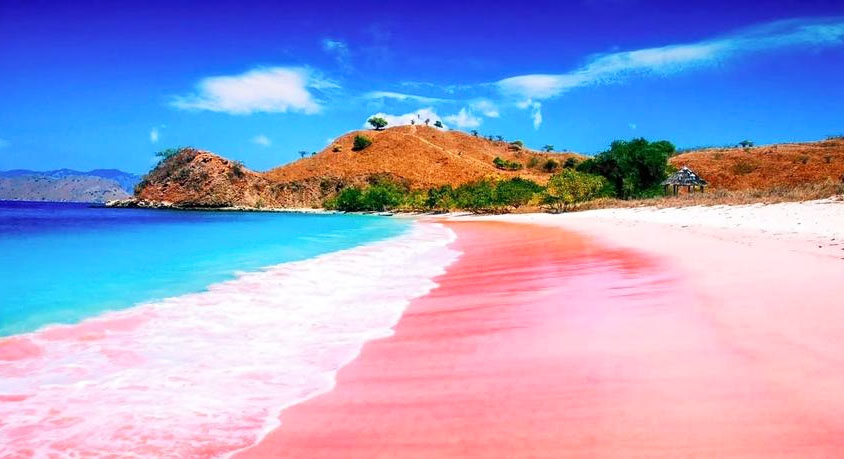
The silence on Barbuda doesn't just hang in the air; it rings in your ears until you start to question if your hearing has actually failed. I was standing on a stretch of sand so impossibly pale it looked like crushed pearls, watching a single frigate bird circle a turquoise lagoon that was entirely, unnervingly empty. No jet skis, no "all-inclusive" buffet lines, and certainly no middle-aged men in neon swim trunks arguing about their Wi-Fi signal. Just as the tide pulled back, revealing a faint, shimmering ribbon of strawberry-pink shells along the waterline, I realized that I hadn't seen another human soul since the boat captain dropped me off at the rickety wooden pier three hours ago. It was the kind of isolation that makes a city-dweller like me feel both like a billionaire with a private island and a stranded extra in a big-budget shipwreck film.
Stepping off the "Barbuda Express" ferry after a ninety-minute, stomach-churning ride from the chaotic harbor of St. John’s in Antigua felt like crossing a portal into a different decade. While the tourists in Antigua are busy fighting for a square inch of sand on Dickenson Bay and paying $25 for a "souvenir" coconut, the financial reality of Barbuda hits you the moment you realize there are essentially no ATMs and only a handful of places that recognize the existence of a credit card. We bypassed the few hyper-luxury resorts that charge $3,000 a night—places that sell the "illusion" of wilderness to celebrities—and instead hired a local driver named Thomas for $60 to be our lifeline for the day. He didn't just drive; he navigated the scrub-cluttered dirt tracks that would have shredded the tires of any standard rental car, proving that on this island, local knowledge is the only currency that actually buys you safety.
Walking into the Codrington Lagoon to see the Frigate Bird Sanctuary required us to board a small, flat-bottomed boat that smelled faintly of salt and aged wood. For about $50 per person, we drifted into the heart of the largest colony of these "Man-O-War" birds in the Western Hemisphere. Watching the males inflate their massive, scarlet throat pouches to the size of a balloon was a primal, raw experience that made the $150 "luxury catamaran cruises" back in Antigua look like a cheap mall attraction. Our guide pointed out a nesting pair just inches from our bow, whispering that the birds outnumber the island's human population nearly twenty-to-one. It’s a jarring realization: on Barbuda, humans are the minor characters, a fact that becomes very clear when you realize the island’s single village, Codrington, is basically two streets and a lot of wandering donkeys.
Hunger on Barbuda is a logistical puzzle that can't be solved with a Yelp search. We ended up at a small shack near the docks where a woman was grilling lobster over an open fire. In Antigua, a fresh lobster lunch with a view will set you back at least $70 per person in a white-tablecloth setting; here, we paid $35 for a crustacean the size of a small dog, served in a styrofoam container with a side of spicy "fungi." We sat on an upturned plastic crate, juice dripping down our chins, watching a wild horse trot past the shack. There were no "tourist prices" vs. "local prices" here, mostly because there aren't enough tourists to justify two different menus. You eat what they caught that morning, or you don't eat at all.
Navigating the 17-mile stretch of Pink Sand Beach involves a level of physical commitment that most vacationers aren't ready for. There are no beach bars, no umbrellas, and no lifeguards. If you run out of water, your "luxury" experience turns into a survival situation very quickly. We spent the afternoon walking until our shadows grew long, and the only tracks in the sand were our own. The "pink" isn't a solid hue—it’s a shimmering effect caused by crushed foraminifera shells that appear and disappear with the light. I saw a couple from a private yacht anchor nearby, step onto the sand for five minutes to take a selfie, and leave. They missed the moment when the sun hit the horizon and the entire coast glowed like a dying ember, a spectacle that cost us nothing but the patience to stay still.
Getting here from New York typically involves a four-and-a-half-hour flight to Antigua, followed by the ferry or a twenty-minute "puddle jumper" flight that feels like flying in a tin can. We chose the winter months, which is "peak" season for the rest of the Caribbean, but on Barbuda, the crowd increase meant seeing five people instead of two. The breeze is constant, which keeps the heat manageable but makes the ferry ride across the open Atlantic stretch a nightmare for the sea-sick. If you attempt this during hurricane season, you’re gambling with more than just rain; the island is so low-lying that a heavy storm effectively shuts down the entire ferry schedule for days.