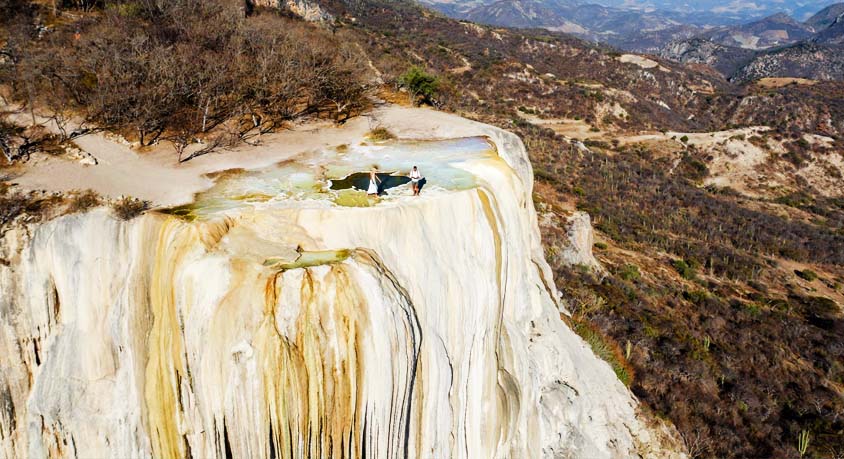
The mountain air at 5,000 feet has a way of thinning out your skepticism, but as I squinted at the massive, jagged overflow of white "water" cascading down the Sierra Norte cliffs, I still didn't believe it. My seven-year-old nephew was already sprinting toward the precipice, shouting that the waterfall had frozen in the Mexican heat. From a distance, Hierve el Agua looks like a colossal mistake of nature, a massive bridal veil of rushing water that someone hit the pause button on ten millennia ago. I stood there for a long moment, watching a hawk circle the valley below, waiting for a single drop to fall from the stony white pillars. It never did. The "waterfall" is actually a calcified mineral deposit, a slow-motion geological leak that has spent centuries turning stone into a liquid illusion, creating one of the most jarring visual paradoxes I’ve ever stepped foot on.
Getting to this petrified marvel from Oaxaca City is the first test of your commitment to avoiding the typical tourist trap. Most people suck it up and pay a tour operator 600 pesos just to sit in a cramped van for nine hours with twelve strangers. I grabbed my friends, walked past the aggressive hawkers near the Zocalo, and found the "colectivos" (shared taxis) heading to Mitla. For about 40 pesos, we jammed into a weathered Nissan where the driver, a man named Jorge with a penchant for 80s power ballads, explained that the real cost of seeing the waterfalls isn't the entry fee, but the "informal" tolls. Once you reach Mitla, you switch to the back of a pickup truck for the mountain ascent. It’s dusty, your hair will look like a bird’s nest, and the local "transportation union" will charge you another 75 pesos, but you’ll see the Oaxacan backcountry in a way that air-conditioned bus windows simply don't allow.
The true magic—and the biggest misconception—happens at the summit's natural infinity pools. Social media influencers would have you believe these pools are steaming hot springs because "Hierve el Agua" translates to "the water boils." In reality, the water is refreshingly cool, and the "boiling" refers to the way the mineral springs bubble up through the earth’s crust. I waded into the turquoise water, the limestone smooth and slightly slimy beneath my toes, and sat right at the edge where the pool overflows into the abyss. Looking down into the valley, you see tiny agave farms stitched together like a green quilt. We spent less than 150 pesos on a lunch of "memelas" and fresh fruit from the stalls near the entrance—prices that haven't been inflated to American levels yet because the hike keeps the laziest crowds at the beach resorts.
If you want to experience the soul of this place without the soundtrack of a hundred shutter clicks, you have to skip the main "waterfall" platform and take the steep, narrow trail that winds down to the base of the formation. Most tourists are too busy taking selfies in the pools to realize that the view from the bottom is where the scale of the "Cascada de Sal" actually hits you. Standing at the foot of a 100-foot wall of solid stone that mimics the fluid curves of a roaring rapid is haunting. I met a local goat herder down there who told me that the "eye" of the spring is sacred, a vein of the mountain that never runs dry even in the harshest droughts. We sat in the shade of a cactus, sharing a bottle of water, and for zero dollars, I received a history lesson that no guidebook could replicate.
When planning this trip from the States, timing is your greatest currency. March is a gamble; the crowds are thinner, but the dust is everywhere. Flights into Oaxaca City from hubs like Dallas or Los Angeles fluctuate wildly, but if you aim for the shoulder season, you can snag a round trip for under $400. Once you're on the ground, the financial "truth" is that Oaxaca is as expensive as you are pretentious. We stayed in a mid-range "posada" for $45 a night that had better coffee and more hand-woven textiles than the $300-a-night boutique hotels in the Reforma district. Avoid eating any meal that has "English Menu Available" printed in a font larger than the food items. Instead, follow the smoke to the "Mercado 20 de Noviembre" and pay 120 pesos for a plate of "tasajo" (thinly sliced beef) that will ruin American steak for you forever.
The one thing no one tells you about visiting Hierve el Agua in the dry season is the "sun tax." The reflection of the sun off the white mineral deposits is blinding; I forgot my polarized glasses in the truck and spent the first hour tearing up like I was at a wedding. It takes about two hours to drive from the city, and if you leave after 9:00 AM, you’ve already lost. We arrived at 8:15 AM, just as the gates creaked open, and had the infinity pool to ourselves for twenty glorious minutes before the first tour bus arrived. That brief window of silence, where the only sound was the wind whistling through the calcified stone pipes of the cliff, was worth every bumpy mile in the back of that pickup truck.