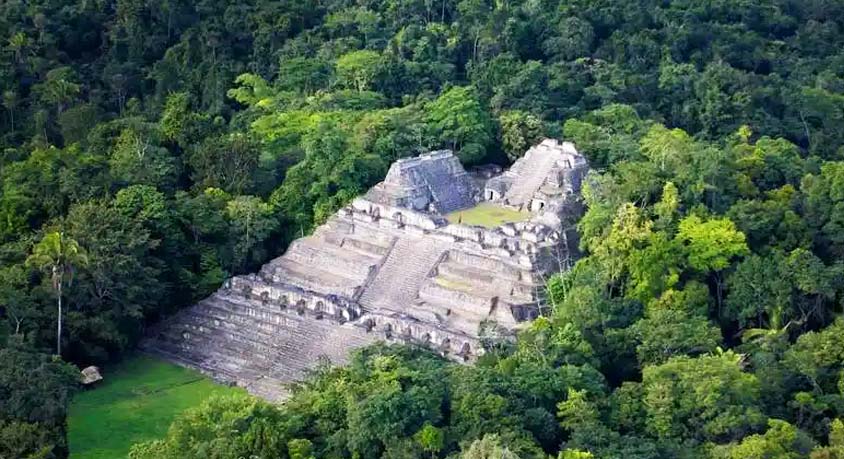
The air was so thick with the scent of damp limestone and decaying tropical leaves that I could almost taste the history as I hauled myself up the final jagged step of Caana. My lungs were burning, but as I stood on the 140-foot summit of this "Sky Place," the sheer absurdity of the silence hit me. There were no tour buses idling in a paved parking lot, no vendors shoving plastic whistles in my face, and definitely no three-hour lines of sunburned tourists in matching neon visors. Just as I let out a breath, a guttural, terrifying roar ripped through the canopy—a troop of howler monkeys sounding like a pack of prehistoric demons. I looked down at my brother, who was a tiny speck on the plaza floor below, and realized we were the only two humans currently occupying a city that once housed 100,000 people. It felt less like a tourist visit and more like we had accidentally wandered onto the set of a post-apocalyptic movie where nature had finally won.
Most people heading to Central America follow the herd to Chichen Itza or Tulum, paying fifty dollars for a sanitized, "don't-touch-the-rocks" experience where you're funneled through gift shops like cattle. We took the contrarian route, bumping along a dirt track for two hours in a rented 4WD through the Mountain Pine Ridge Forest Reserve to reach Caracol. If you’re coming from the States, the travel time is the real barrier; it’s a three-hour flight to Belize City, but the real journey is the bone-jarring trek into the Chiquibul Forest. We bypassed the $250-per-person guided "luxury" vans from San Ignacio and rented our own rugged Jeep for $85 a day. The suspension groaned with every pothole, but the freedom to arrive before the three small vans of day-trippers showed up was worth every rattling tooth.
Sleeping in the Cayo District rather than the overpriced beach resorts on the Cayes saved our budget before the trip even started. We found a sprawling guest house in San Ignacio for $65 a night, a place where the "lobby" was a hammock-filled porch and the morning alarm was the sound of a neighbor’s rooster. In San Pedro or Caye Caulker, that same $65 wouldn't even cover a mediocre dinner for two at a place with a view. Here, it bought us a room with a ceiling fan that worked precisely 60% of the time and a host who gave us a handwritten map of the "secret" swimming holes that aren't on Google Maps. The financial contrast is sharp: you can pay for the "Instagram version" of Belize on the coast, or you can pay local prices in the jungle and actually see the country’s bones.
Lunch was a greasy, glorious pile of "fry jacks" and stewed chicken we picked up at a roadside shack for about five Belizean dollars—roughly $2.50 USD. I watched a group of travelers at a nearby resort café pay $18 for a "Mayan-inspired wrap" that was essentially a tortilla filled with sadness and tourist tax. The woman serving us at the shack laughed when I asked if she had a menu; she just pointed at the pot on the stove and said, "Chicken or beans, honey." We took the chicken, sat on a wooden bench, and realized that the "local price" isn't a secret society—it’s just the price you pay when you stop looking for a place that serves avocado toast.
Navigating the interior of Belize is surprisingly easy if you ignore the taxi drivers who hover at the border like vultures. We used the "Chicken Buses," those brightly painted, retired American school buses, for our shorter hops between towns. It’s $2 to travel forty miles, compared to a $60 private cab ride. Sure, you might be sharing your personal space with a crate of live iguanas or a massive bag of corn, but the lack of hidden "tourist fees" is refreshing. There are no tolls on the Western Highway, just the occasional stray cow and the realization that walking through San Ignacio is free, vibrant, and infinitely more interesting than sitting in a sterilized hotel shuttle.
We spent an afternoon at Rio On Pools, a series of natural granite basins and waterfalls just a short drive from the Caracol turnoff. While the "famous" Barton Creek Cave tours charge $90 for a canoe ride, Rio On Pools was absolutely free. We slid down smooth rock slides and sat under freezing cascades while the sun baked the pine needles overhead. It’s a location that travel agencies skip because they can’t figure out how to charge you for it. Later, we hiked into the Rio Frio Cave, a massive limestone archway that feels like entering a cathedral built by giants. There was no entrance fee, no guide, and no "no flash photography" signs—just the sound of our own footsteps echoing off walls that haven't seen a crowd in a thousand years.
If you’re traveling during the rainy season, you need to be prepared for the "roads" to become rivers of red clay that will swallow a compact car whole. We went just as the dry season was ending, which meant the heat was a physical weight, but the artifacts were dry and the hiking trails weren't mudslides. Prices for flights from the US tend to dip in late spring, making it the perfect time to trade the overcrowded ruins of Mexico for a place where you can still touch the carvings and feel the moss under your fingernails.