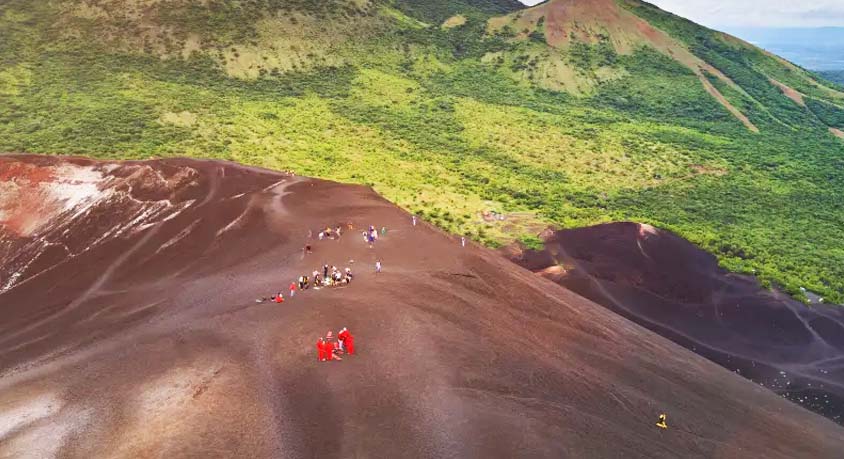
The gravel crunched under my boots like broken glass, and every breath I took was flavored with a faint, metallic tang of sulfur. I was standing on the rim of Cerro Negro, a charcoal-black cone rising out of the Nicaraguan plains, clutching a plywood board that looked like it had been salvaged from a middle-school shop project. Below me, a 41-degree slope of volcanic ash plummeted into the abyss, and for a split second, the only sound was the wind whipping my bright yellow jumpsuit. My brother leaned over, his goggles already fogged with grit, and yelled, "If we survive this, the beer is on me." I looked at the vast, green valley stretching toward the Pacific and realized that the headlines I’d read back in the States—the ones dripping with warnings about "instability" and "danger"—had never felt more like a work of fiction.
Strapping my feet into that board and pushing off was a lesson in physics and pure, unadulterated terror. The first ten feet were a slow crawl, but by the thirty-foot mark, the volcanic scree turned into a fluid treadmill, and suddenly I was a human projectile hurtling toward the bottom at roughly 50 miles per hour. Ash pelted my face like tiny hailstones, and my gloved hands dug into the grit to steer, creating a massive plume of black dust behind me. It’s an extreme sport that would be bogged down in $500 insurance waivers and safety briefings in Colorado, but here in León, it’s just another Tuesday. For $30, we got the hike, the gear, a ride in the back of a beat-up 4x4, and a celebratory mojito at the end. Comparing that to the price of a lift ticket at a mediocre Vermont ski resort feels like comparing a feast to a crumb.
León itself is a city that doesn't just exist; it breathes through its crumbling colonial facades and vibrant street life. We bypassed the $120-a-night "luxury" boutiques and found a room in a converted colonial house with a central courtyard filled with tropical ferns for $40. The ceiling fan rattled like a helicopter, but the water in the shower was cold—which, in the 95-degree heat of the Nicaraguan lowlands, is a feature, not a bug. Most travelers stick to the sanitized streets of Granada, but León has a grit and a pulse that makes you feel like you’ve actually left home. You aren't a "guest" here as much as you are a temporary neighbor.
Eating our way through the central market, we found the real financial truth of Nicaragua. A woman with calloused hands and a perpetual smile handed me a Vigorón—a heap of boiled yuca, crispy pork rinds, and cabbage salad served on a banana leaf—for exactly $2.50. I watched a group of tourists at a "fusion" restaurant across from the cathedral pay $18 for a burger that looked like it came from a frozen box. The disparity is almost comical if you’re willing to sit on a plastic stool and eat where the locals eat. We spent our afternoons at a hole-in-the-wall ceviche stand where $1 bought a cup of lime-cured snapper so fresh it practically still had a heartbeat.
Getting around the city doesn't require an app or a pre-booked shuttle. We flagged down "colectivos"—converted trucks with benches in the back—to get to the nearby beach of Las Peñitas. The fare was about 50 cents, and we shared the ride with three surfboarders, a man with a crate of chickens, and a teenager playing reggaeton on his phone. It’s a forty-minute sweat-fest through the dusty plains, but it beats paying $25 for a private taxi that will just get stuck behind the same slow-moving ox carts anyway. There are no hidden fees or "tourist surcharges" on these trucks; you just hand your cordobas to the driver and hope you don't get a face full of dust.
We hiked up to the roof of the Basílica de la Asunción, the largest cathedral in Central America, and were told to take off our shoes to preserve the brilliant white plaster. Walking barefoot across that scorching, blindingly white roof felt like walking on the surface of the moon, with the volcanic chain of the Maribios lining the horizon. It cost $3 to enter, a price that would barely cover the "convenience fee" for a museum ticket in New York. Later, we found the Museum of Traditions and Legends, housed in a former prison, where hand-crafted effigies tell stories of local folklore for a $2 donation. These aren't polished, high-tech exhibits; they are raw, tactile pieces of a culture that refuses to be overshadowed by its neighbors.
Flying from the States involves a hop into Managua, usually through Miami or Houston, and then a 90-minute drive that will test your patience with potholes. We went during the "dry season" between January and March, which means the dust is omnipresent and the sun is a physical weight on your shoulders. The wind picks up in the afternoons, clearing the volcanic haze but also making the "board" hike a bit more of a struggle. Prices for flights from the East Coast were surprisingly reasonable, often under $500 round-trip if you skip the holiday weeks.