I was standing at the Antelope Canyon tour check-in desk, watching a family of six hand over what looked like a mortgage payment for a ninety-minute walk, when the woman behind me said into her phone, “Yeah, we got the photo package too, just in case the light beams show up.” I stepped out of line, pretended to check my parking meter, and thought: there has to be a version of this trip that doesn’t feel like buying a timeshare.
The thing nobody tells you about Antelope Canyon is that the experience you’re paying for—the slot canyon, the light, the quiet—exists all over this stretch of desert, and some of it doesn’t require a ticket, a guide, or a waiver form. I learned this on accident, three hours after skipping the tour. I was sitting on the edge of a dirt pull-off just outside Page, eating a gas station burrito, when a guy in a dusty truck parked next to me and asked if I was lost. I told him I was trying to figure out how to see the canyons without spending the rest of my vacation budget in one morning. He laughed, pointed east toward a ridge I hadn’t noticed, and said, “Drive up there. Park before the fence. Walk until the ground drops.”
That ridge led to a place called Water Holes Canyon, which isn’t a secret if you’re local but might as well be invisible if you only follow Instagram. The entry is unmarked, the parking is free, and the walk in takes about twenty minutes across slickrock that glows orange in the morning light. When you drop into the canyon itself, the walls close in the same way they do in the famous photos—narrow, striated, the occasional beam of light cutting through if you time it right—but there’s no line, no guide telling you to keep moving, and no one rushing you toward a gift shop exit. I sat on a sandstone shelf for forty-five minutes watching the shadows shift, and the only sound was the wind pushing through the narrows and the occasional crunch of my own boots when I shifted position.
Everything in Page feels priced for the person who flew in for forty-eight hours and won’t question a $180 hotel room or a $14 sandwich because they’re already mentally checked out on their credit card. We did the opposite. We booked a condo with a kitchen off Lake Powell Boulevard for $135 a night, split between three of us, which meant breakfast was eggs from the grocery store and coffee we brewed while watching the sun hit the mesa behind the complex. That single choice saved us around $60 a day compared to eating out. The one meal we did pay for—Navajo tacos from a stand outside the cultural center—cost $8 each and came with fry bread so good I still think about it while making dinner at home.
The overlooked spots in this area don’t announce themselves. There’s a hike called the Toadstools, about forty minutes north of Page on the Utah side, that gets a fraction of the traffic Antelope does but gives you hoodoos shaped like mushrooms balanced on sandstone pedestals, the kind of geological weirdness that makes you stop and laugh because it looks like a cartoon. The trailhead is just a dirt lot off Highway 89 with no fee box, no restrooms, no signage beyond a small wooden post. We walked out at sunset, watched the hoodoos turn from gray to gold to deep red, and passed exactly two other people on the mile-long trail. One of them was a geologist who pointed out fossilized tracks in a slab of rock I would have walked right over.
Another place that exists outside the tour-bus circuit is the old Navajo Bridge, about an hour west near Marble Canyon. Most people stop at the new bridge, walk the pedestrian path, take a photo of the Colorado River cutting through the gorge, and leave. The old bridge, decommissioned in 1995, sits right next to it, closed to vehicles but open to anyone who wants to stand on a steel span built in 1929 and watch California condors glide underneath. We stood there for twenty minutes while a ranger with a spotting scope pointed out three condors riding the thermals, their wingspans so wide they looked like small planes. The ranger didn’t charge anything. She just liked showing people birds.
If you’re flying from the East Coast, the math gets easier if you skip Phoenix. We flew into Las Vegas on a Wednesday in October, paid $240 round-trip, and drove four hours to Page through the Virgin River Gorge, which is worth the drive on its own. The rental car was $210 for five days. The drive back included a stop at the Grand Canyon’s less-visited North Rim, which closes for winter in mid-October but was still open during our trip, with no crowds and a view of the canyon that felt like we’d discovered it by accident. The entry fee was $20 for the car, but we’d already bought an America the Beautiful pass earlier in the year, so it cost us nothing extra.
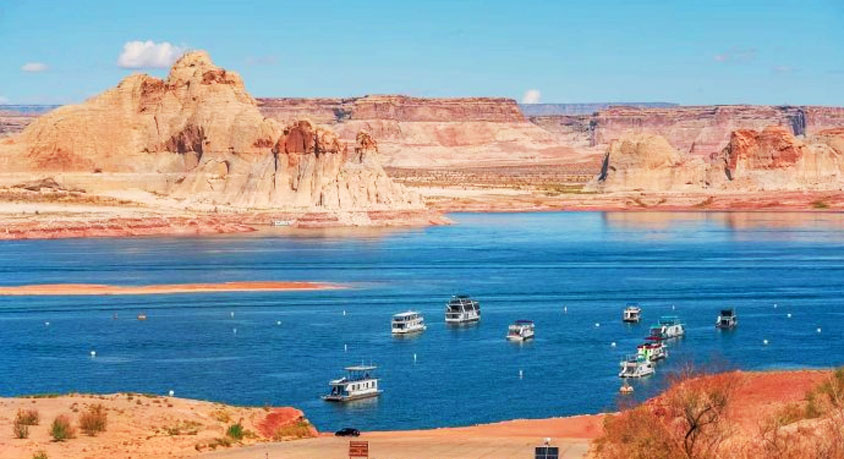
One afternoon we drove to the Wahweap Overlook, a spot that doesn’t show up on the main park maps because it’s not inside the Glen Canyon Recreation Area boundary. You park on a dirt turnout, scramble up slickrock following cairns, and after fifteen minutes you’re standing on a sandstone fin looking down at the lake winding through canyons the color of terracotta. A local had told me about it at the grocery store, saying, “That’s where I take my kids when I don’t want to pay the entrance fee.” We stayed until the light turned the water into a sheet of hammered copper, and the only other person up there was a guy fly-fishing from a ledge, casting into a pool so far below that his line disappeared before the sound of the reel reached us.
The lesson I took away from this stretch of desert is that the expensive version of the trip sells you convenience, but the real version sells you space. The tours, the hotels, the packaged experiences—they’re all designed around the assumption that you don’t have time to figure things out yourself. But if you give yourself one extra day, ask a few questions at the grocery store, and drive past the first crowded lot you see, you end up with something the tour buses can’t deliver: a canyon you don’t have to share, a view you didn’t pay for, and a memory that doesn’t come with a receipt.