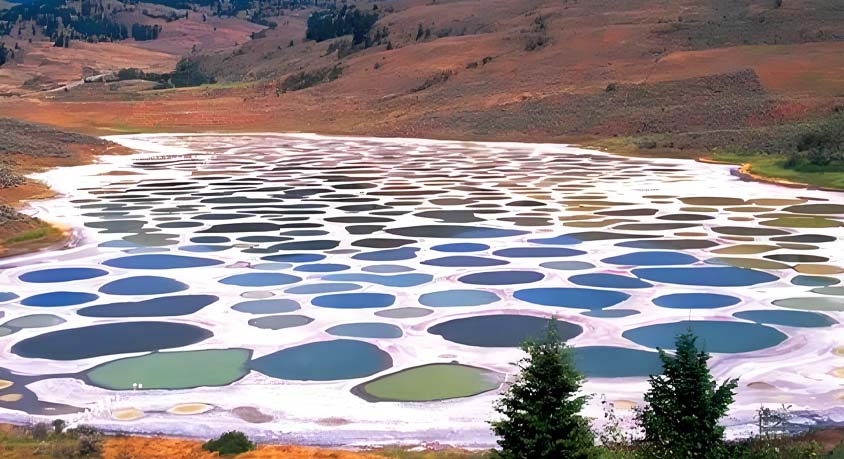
I was standing on a dusty pull-off along Highway 3, squinting through a chain-link fence, when a local teenager biking by shouted, “It’s not a toxic spill, I swear.” I laughed, but honestly, that was my first thought. Below me, the ground looked like a giant’s palette had exploded—hundreds of perfect, pale-yellow circles ringed in turquoise, scattered across a shallow basin. This was Spotted Lake, and in that moment, I realized every over-edited Instagram post I’d ever seen had done it a disservice. They make it look like a surreal painting; in reality, it’s weirder, more alive, and far more personal than any filter could capture.
My brother and I had been driving from Vancouver, our third “let’s finally do this” road trip in as many years. The plan was loose: chase the Okanagan’s wine country, but avoid the crowds. We pulled into Osoyoos at noon, the desert heat hitting us like a furnace door left open. The lake isn’t something you hike to; it’s something you stumble upon. We parked at the designated viewing area, a small gravel lot just off the road. No ticket booth, no crowd. Just a few informational signs explaining that for the Okanagan Nation, this is a sacred site—a place of healing, not a swimming hole. That’s the first thing most tourists get wrong. They come expecting a resort experience. But the true cost of entry isn’t money; it’s respect. You don’t touch the water because the mineral concentration—magnesium, calcium, silver, titanium—is so high it’ll leave a residue on your skin, and frankly, you don’t want to be that person ignoring the “sacred site” signs for a selfie.
The best view isn’t from the designated platform. If you walk about 200 meters further down the highway, past the fence’s end, there’s a low embankment where the property line is less defined. We sat there for an hour, just watching the spots shift as the sun moved. The “spots” are actually mineral deposits left behind as the summer sun evaporates the water. In mid-July, they were at their peak—some were the size of coffee tables, others as big as cars. My brother, an engineer, started calculating the mineral composition out loud while I just watched a bald eagle circle overhead, its shadow gliding over the circles like a slow-moving hand. We had a bag of cherries from a roadside stand ($8 for a massive bag, a fraction of what you’d pay in Vancouver) and just sat there, listening to the buzz of bees and the occasional whoosh of a semi-truck. It was a moment of profound stillness that no guided tour could ever manufacture.
We stayed in a motel in Osoyoos proper—the Sahara Courtyard Inn, a total throwback with a giant cactus out front. During the week, it was $129 CAD a night. On the weekend, that same room jumps to $289. The “reverse tourism” trick here is simple: arrive on a Monday, leave on a Thursday. We ate at a diner called “The Gasoline Alley” where a classic burger and fries was $12, while the “wine bar” in the same strip had a charcuterie board for $28 that was just pre-packaged crackers and a few sad olives. Locals were all at the diner. We followed them. For dinner, we drove 15 minutes to Keremeos—known as the “fruit stand capital of Canada”—and bought heirloom tomatoes, fresh bread, and a block of local gouda for $20. We ate it on a picnic table overlooking a vineyard, the total cost less than one entrée at a tourist-trap winery. The real “price” of this place isn’t your accommodation; it’s your willingness to drive 10 minutes away from the main drag.
For those wanting to go deeper than the roadside view, the true hidden gem is the guided interpretive walk led by the Okanagan Nation Alliance. It’s not heavily advertised; you have to inquire at the Osoyoos Visitor Centre. For a $10 donation, a young Indigenous guide named Tessa walked us along the periphery, explaining that her grandmother’s grandmother came here to collect the mineral mud for healing. She pointed out the different colors: the white circles are calcium and magnesium sulfate; the blue-green ones are copper. She told us that the lake “breathes,” that the spots change shape and size daily based on the wind and temperature. “You’re not looking at a lake,” she said, “you’re looking at a pharmacy.” That walk reframed the entire experience. It took the site from a “cool photo op” to a living piece of cultural history. That’s the kind of experience you can’t buy with a VIP pass.
Another overlooked spot is the Nk’Mip Desert Cultural Centre, just a five-minute drive from the lake. Most people skip it, thinking it’s a “museum” that will take hours. It’s not. It’s a stunning building half-buried into a hill, with a short, self-guided trail out back that showcases the actual desert ecosystem—rare antelope brush, burrowing owls, and a recreated village. The entry is $15, and it’s worth it for the air conditioning alone on a 38-degree day. But the real value is the perspective: you realize the lake isn’t an isolated oddity; it’s the centerpiece of a whole desert landscape that most people think doesn’t exist in Canada. We spent two hours there, mostly sitting on a shaded bench, watching a yellow-bellied marmot dart between rocks. It was quiet, nearly empty, and felt like we’d stumbled into a secret.
A word on the season: come between late June and early September, but don’t expect to “do” the lake in an afternoon. The light is key. Early in the morning, the circles are in shadow and look flat. The magic window is from 11 a.m. to 3 p.m., when the sun is directly overhead and the mineral rings are most distinct. But that’s also when the heat is brutal. We learned to go for a swim at the Osoyoos Lake (the “regular” lake, which is warm as bathwater) in the morning, then hit Spotted Lake around noon, then retreat to the Cultural Centre or a fruit stand during the peak heat. And bring cash—the fruit stands and the donation for the guided walk don’t take cards. We watched a family frantically trying to Venmo a teenager selling peaches because they had no cash. Don’t be that family.