I was cruising through the mountains outside Denver last summer in a friend’s Toyota 4Runner. The outside temperature was pushing 98 degrees, we were pulling a long grade at 7,000 feet, and the air conditioning was fighting a losing battle against the sun. I glanced at the coolant temperature gauge. Right where it always sits. Dead center. Perfect. Normal. Then I smelled it. That sweet, sickly scent of boiling coolant. A thin wisp of steam curled from under the hood near the passenger side. The gauge hadn’t moved. Not a millimeter. My buddy looked at it and said “We’re fine, it’s right in the middle.” I pulled over anyway. The overflow tank was burping like a coffee pot on a hot plate. The gauge had been lying to us for the last five miles.
Here’s something the car manufacturers don’t want you to know. That temperature gauge on your dashboard isn’t a scientific instrument. It’s a pacifier. It’s designed to sit dead center across a massive temperature range—usually anywhere from 160 degrees all the way up to 230 or even 240 degrees—without moving. The engineers call it a “buffered” gauge. I call it a deception. They program the ECU to hold the needle right in the middle during normal operation so drivers don’t call the dealership panicking every time the engine warms up to 210 degrees on a hot day. But the side effect is that you, the driver, have absolutely no idea when your engine is actually starting to cook until it’s already boiling the coolant out of the radiator.
In a modern Honda Civic, a Toyota Camry, or a Ford F-150, the coolant temperature sensor sends a signal to the engine computer. The computer decides what to show you on the gauge. From about 170 to 220 degrees, that needle isn’t moving. It’s locked. The computer is telling you “everything is fine.” But here’s the problem. When you’re towing a boat with that F-150 up a long grade, or you’re stuck in stop-and-go traffic in Phoenix in July, your engine might be running at 235 degrees. The coolant is stressed. The oil is thinning out. The head gasket is getting pushed to its limit. And your gauge? Still dead center. Still smiling at you like nothing’s wrong.
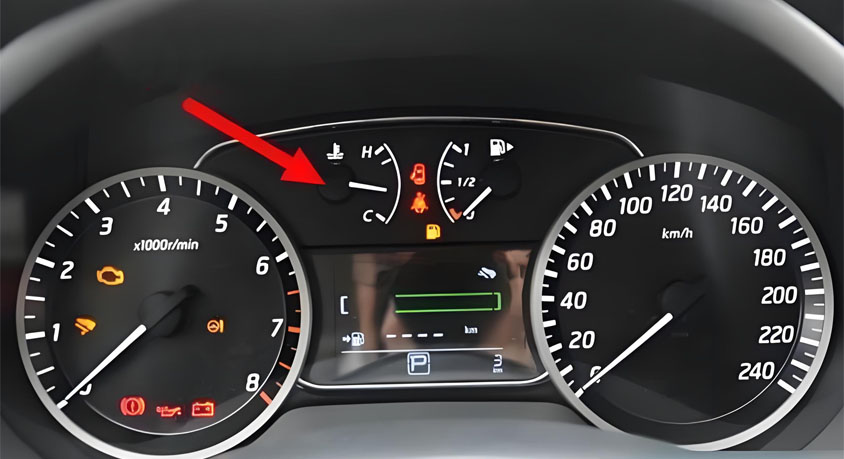
The first time you’ll see that needle actually move is when the coolant temperature hits the manufacturer’s programmed “panic zone.” Usually somewhere between 235 and 245 degrees. At that point, the gauge will suddenly swing toward the red. But here’s the kicker: by the time that needle moves, your engine is already in serious trouble. The aluminum cylinder head is expanding. The head gasket is under extreme pressure. If you have a Subaru with the boxer engine, you’re basically rolling dice on whether you’ll need to replace the gaskets next week. If you have a BMW with the N55 or B58, you’re flirting with a plastic coolant flange failure that will dump your entire cooling system in thirty seconds.
The sensory difference between “normal” and “overheating” is something you have to learn to feel and smell, because your gauge won’t tell you. The first sign is heat. Not from the vents—from the floor. When the cooling system starts to struggle, the heat soak into the cabin increases. You’ll feel it rising up from the transmission tunnel, a wave of warmth that has nothing to do with your HVAC settings. Then there’s the smell. Coolant that’s pushing past its limit has a distinct sweet, almost maple-syrup odor. If you smell that inside the cabin or around the front of the car, your cooling system is already venting pressure. Then there’s the AC. When the engine temperature climbs, the ECU will often cut power to the air conditioning compressor to reduce load. If your AC suddenly starts blowing warm air on a hot day, your engine is telling you it’s in trouble. The gauge won’t.
I’ve seen this across brands. Toyota is notorious for programming their gauges to be incredibly lazy. A 4Runner or Tacoma will sit perfectly centered while the coolant hits 230 degrees. It’s designed that way to reduce “customer anxiety.” But a Toyota owner who tows a camper in the Sierra Nevada mountains might never know they’re running hot until they see steam. Compare that to a Mazda CX-5 or a Volkswagen GTI. Their gauges are more honest. They move. They give you feedback. When I’m driving a Mazda up a mountain pass, I can watch the needle climb a few degrees, then drop back down when the thermostat opens. That’s information. That’s a car that treats me like an adult instead of a child who needs to be kept calm.
So what do you do about this? You stop trusting the dashboard ornament and start using real data. Spend thirty bucks on a Bluetooth OBD2 adapter and a phone app. That will show you the actual coolant temperature in degrees, updated in real time. You’ll learn what your engine’s normal operating range actually is. For most modern cars, it’s somewhere between 190 and 210. When you see it hit 225 on a long grade, you know it’s time to back off, turn the heater on full blast, and let the system catch up. The gauge won’t tell you that until it’s too late.
And for the love of engines, stop assuming that “the needle hasn’t moved” means “everything is fine.” I learned that lesson with the 4Runner, and I’ve seen it cost people head gaskets, warped cylinder heads, and engines that never run quite right again. Your dashboard gauge is designed to keep you comfortable, not informed. It’s a lie. A comfortable, well-intentioned lie that can cost you an engine if you believe it too long. Learn to smell the sweet scent of trouble before your wallet has to.