I was standing at a gas station last Sunday, waiting for my coffee to finish brewing, when I watched a guy in a brand-new black Ford F-150 pull into the automatic wash bay. The big rotating brushes dropped down, and I physically winced. He sat there in his cab, scrolling on his phone, while those bristles—still loaded with the grit from the mud-caked Jeep that went through five minutes earlier—spun against his paint like a floor buffer on a hardwood deck. When he pulled out, the truck looked clean. Shiny. Reflective. But I knew what the sun would show him the next morning. A million tiny scratches. A haze of swirl marks that no wax would ever hide. He paid twelve dollars for the privilege of having his clear coat sanded down. And he probably thought he was taking care of his truck.
I’m going to say something that will offend the convenience-loving, time-starved masses. The automatic car wash with spinning brushes is the single worst thing you can do to your paint short of keying it yourself. Those brushes aren’t soft. They’re not gentle. They’re industrial-grade nylon bristles that act as carriers for every particle of dirt, sand, and road grime from every car that went through before you. The wash bay doesn’t clean the brushes between cycles. They just spin, collecting grit, and then that grit gets pressed against your clear coat with enough force to strip wax and leave microscopic scratches that compound over time. It’s not washing. It’s abrasion. And if you drive a car with soft Japanese paint—like a Subaru, a Mazda, or a Honda—you’re basically volunteering for a factory-finish removal service.
The visual evidence is everywhere once you know what to look for. Walk through any grocery store parking lot on a sunny day and look at the dark-colored cars. The black BMWs, the navy Toyota Camrys, the deep red Mazda CX-5s. Turn your head so the sun catches the hood at an angle. See those fine, spiderweb-like lines radiating in every direction? Those aren’t “normal wear.” Those are automatic wash scars. A car that’s been hand-washed properly—with a clean microfiber mitt and the two-bucket method—has a reflection that’s deep and uninterrupted. An automatic-wash car looks like someone took a Scotch-Brite pad to a mirror. It’s dull. Hazy. Dead. And the resale value reflects it.
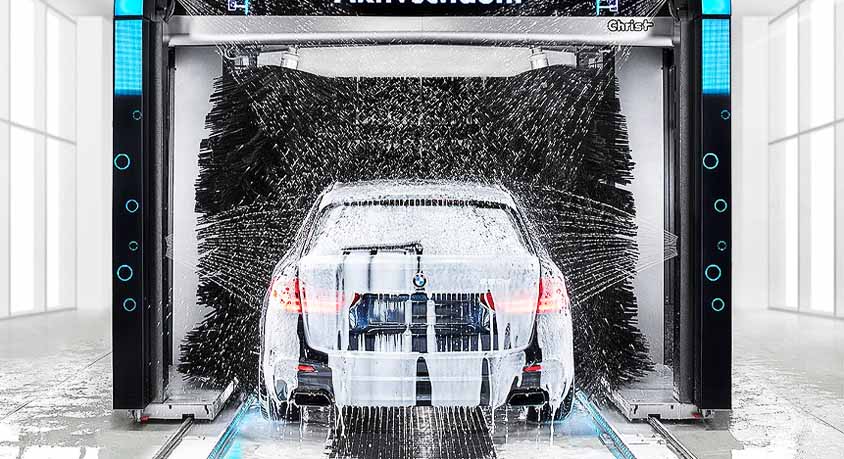
I’ll admit, I have a bias here. I hate those rotating brushes with the same visceral disgust I have for hideaway door handles and touchscreen climate controls. They’re marketed as convenience, but they’re actually laziness packaged as maintenance. The worst offenders are the gas station washes that use the same brushes for months without replacement. I’ve seen those bristles frayed down to the plastic backing, meaning you’re not even getting nylon anymore—you’re getting hard plastic scraping against your paint. Compare that to a proper touchless wash, which uses high-pressure water and detergents without any physical contact. A touchless wash won’t get your car perfectly clean if it’s caked in mud, but it also won’t etch swirl marks into your clear coat. A touchless system on a Ford Explorer or a Toyota RAV4 leaves the paint intact. The brush system on the same vehicles? You’re trading two years of gloss for ten minutes of convenience.
The sensory difference between a car that’s been cared for and one that’s been automated is something you can feel, not just see. Run your hand across the hood of a car that’s been through the brush wash a hundred times. It feels slightly rough. Like fine-grit sandpaper. That’s the clear coat being microscopically scoured. Now run your hand across a car that’s been properly hand-washed. It feels like glass. Slick. Smooth. When you dry it with a clean microfiber towel, it glides. When you wax it, the product spreads evenly and buffs off with zero resistance. That’s paint that still has its factory depth. That’s a car that hasn’t been slowly sanded down every Saturday morning.
I’ve seen what this does across brands. A Mercedes-Benz with ceramic-hard clear coat will resist swirls longer than a Honda, but even German paint gives up eventually. A Tesla? Their paint is notoriously soft. A year of automatic washes on a Model 3 and the thing looks like it’s been through a sandstorm. The owners are shocked when they go to sell it and get lowballed because the car “looks old.” It’s not old. It’s just been abraded. Compare that to a Porsche 911 that’s been hand-washed its whole life. Ten years old, and the paint still has that deep, wet-looking glow that makes people stop and stare. Same mileage. Same years. The difference is who touched the paint and what they touched it with.
Here’s what I do, and what you should do if you actually value the finish on your car. First, stop going to brush washes. Full stop. If you need convenience, find a touchless wash. It’s not perfect, but it won’t actively destroy your clear coat. Second, learn the two-bucket method. One bucket with soap, one with clean water for rinsing your mitt. Use a microfiber wash mitt, not a sponge. Sponges trap grit against the paint. Microfiber pulls it away. Third, dry with a clean microfiber towel, not a chamois or a squeegee. Squeegees are paint razors. And if you really want to protect your investment, get a ceramic coating or a quality sealant applied. That coating acts as a sacrificial layer. The brushes still scratch it, but they scratch the coating instead of your clear coat. You reapply the coating every couple years instead of repainting the hood.
I know people will read this and say “I don’t have time to hand wash my car.” To them I say: you have time to take it to a wash bay. You have time to scroll through your phone while the brushes grind against your paint. That same twenty minutes can be spent in your driveway with two buckets and a mitt. Your car will be cleaner. Your paint will last longer. And the next time you park next to a car that’s been through the automatic torture rack, you’ll see the difference. Theirs will look like a faded photograph. Yours will look like the day you drove it off the lot. That’s not vanity. That’s preservation. And it starts with refusing to pay strangers to sandpaper your car.